The Risks of 'YouTube Lawyering'
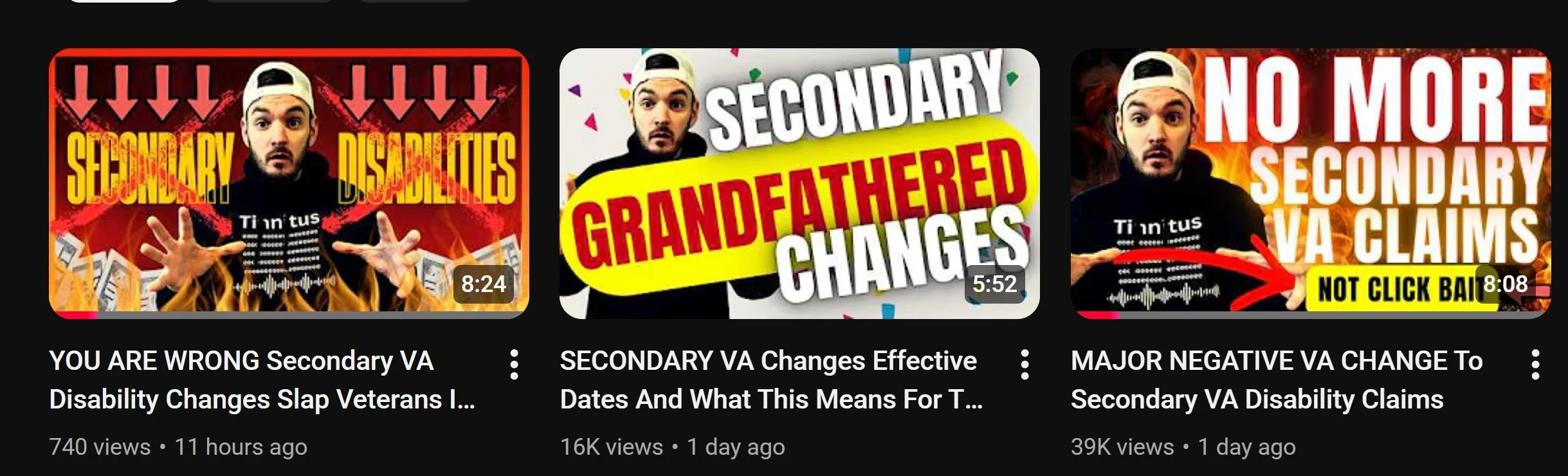
Pull up a chair and let’s talk for a minute. The gnats are starting to swarm down here in Georgia, but not yet swarming as bad as the nonsense coming out of the “advice” circles on the internet. There’s a saying we use: better to keep your mouth shut and appear stupid than to open it and remove all doubt. Lately, I’ve been seeing some folks—bless their hearts—getting all worked up over a video floating around about "major negative changes" to secondary service connection.
This particular fellow is out here claiming that the VA just pulled the rug out from under you. He’s saying the 50/50 "at least as likely as not" standard is dead and gone, replaced by some 100% "but-for" causation monster. Now, I’m not here to be the fun-police, but when a non-accredited source starts "interpreting" complex legal cases, the M21-1 Adjudication Manual, etc., you end up with a mess that’s harder to clean up than a spilled bucket of oysters. Although, he claims to "work under" some other guy’s accreditation. So, who knows. Either way, we got some problems.
Check out his videos then come back.
Straight From the Front Porch
Let me give you what happened with some straight talk. Our friend on the computer screen is confusing how a condition is linked with how much evidence you need to prove it. A few years ago, a Court case came out named Spicer v. McDonough. In Spicer, the Federal Circuit clarified what is needed to establish secondary service-connection (think OSA secondary to PTSD, depression secondary to cancer, etc.). Prior to this case, the VA had been applying a “proximately due to” standard of proof. Following Spicer, the Court clarified that a Veteran must only show "but-for" causation. At first it sounds really confusing, but I will explain it to you real nice and easy in a second. Back to Spicer. Spicer was made the law of the land March 8, 2023. No one on YouTube noticed, no one seemed to care. Notice how despite being the law of the land for three years, the sky hasn’t fell out, secondary claims are still being granted, and folks are still complaining about gas prices. Business as usual, right?
So, what changed? Well, last week, VA amended the M21-1 to finally, some three years late, update its guidance to comply with Spicer. Hey. Not bad for the VA—three years ain’t too bad. Because it is fairly easier to get subscribed to the M21-1 updates versus actually keeping up with ongoing litigation, the YouTube lawyers went nuts.
The Mule in the Tomato Patch
To understand "but-for" causation, you don't need a law degree, you just need to follow this example. Imagine I’m at my house and I accidentally leave the gate to my pasture open. But-for me leaving that gate open, my mule would’ve never wandered out. But-for that mule wandering out of the pasture, he’d never have made his way over to my neighbor’s garden to eat every last one of those prize-winning tomatoes. But-for my neighbor’s tomato being eaten, he would have never lost the county fair.
In the law, that’s all "but-for" means. It’s a chain of events. It’s not about being "100% certain" of a medical mystery; it’s about showing that Step Z happened because Step A paved the way. When the VA uses this language, they aren't saying you need a higher level of proof, they’re just asking if the "mule" (your secondary condition) would’ve stayed in the "pasture" if the "gate" (your service-connected injury) hadn't been left open.
Now let’s do the same example but prior to Spicer. My mule wanders out. But instead of walking straight to the neighbor's garden, he gets spooked by a passing tractor, runs three miles down the road, kicks over a beehive, and then the bees sting a prize-winning bull, causing the bull to stampede through the neighbor’s tomato patch. Under a "proximately due to" standard, the VA would look at me and say: "Leaving the gate open was the start of the trouble, but it wasn’t the 'proximate' cause of those squashed tomatoes. The tractor and the bees were intervening forces that made the result too remote." Therefore, no dice. No secondary service-connection for you. In the VA world, "proximately due to" means the service-connected disability has to be a substantial factor in bringing about the secondary condition. It’s a tighter knot, higher up on the ladder. It requires the link to be direct and foreseeable, not just a "one thing led to another" story under the but-for standard.
If my mule eats the tomatoes, "but-for" only cares that the gate was open. It doesn’t care if the mule took a scenic route or got help from a tractor. By moving toward "but-for" language in the manual—thanks to the Spicer case—the VA is actually being forced to look at a wider range of ways your injuries are connected.

Don't Let 'Em Move Your Fence Posts
When you hear a YouTube lawyer tell you that "but-for" is a 100% certainty standard, they are fundamentally upside down on the law. They are taking a tool meant to help you prove a connection and telling you it’s a wall meant to shut you out. It’s like someone telling you that a wider gate makes it harder to get the tractor through. It just don't make sense. If you’re confused about whether your "mule" is secondary to your "gate," don’t go looking for answers on YouTube. Come talk to someone who’s spent their life reading the fine print so you don't have to. This also illuminates the larger point on the importance of qualified representation that requires ongoing CLE hours, but that’s a story for another day.
Godspeed.