Contract Examiners Can’t Access Your C-File
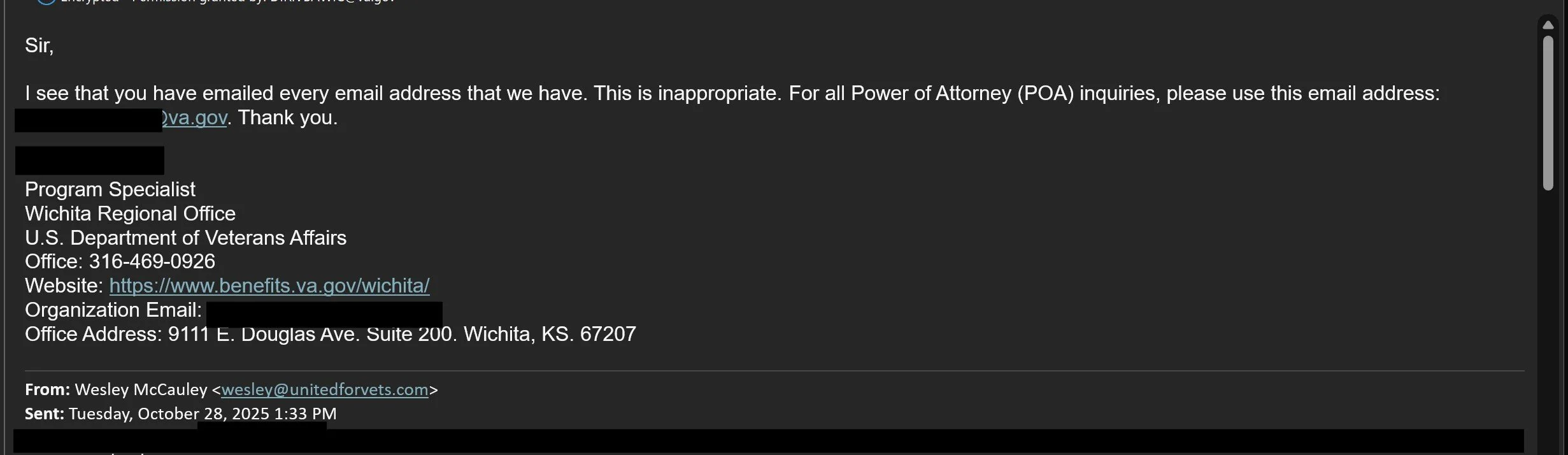
I get scolded some of all of the time by the VA. You can’t contact us! We are supposed to be nameless and faceless—how did you even get our e-mail?!? Wonder if they called up their union rep. on this one? Are there any safe spaces left in Doug Collins’ VA? Doubt it. (Rumor has it the Secretary is making OGC leave their ivory tower building and move in with the rest of the normal VA employees. I like that change.) Some within the walls of the VA say I am downright “inappropriate.” Sorry. I don’t know any better. Frankly, nor do I care. I am here to get benefits for Veterans, not protect bureaucrats.
I have been chewing on this cigar for a while now. Since 2023 to be exact. I wanted to collect evidence. It is a Churchill—the big daddy to say the least. The hair on the back of my neck first began to stand up around that time. I was (and still am) representing this ole’ Navy boy. He messed up his knee pretty bad. Messed up, yeah, that’s the word we’ll use.
I think you know what I really mean. Anyhow, in true Navy fashion, they had a miracle drug, a cure all. It was better than anything Grandma’s home medicine book had, knocking the socks off homemade chicken noodle soup. That’s right, I’m talking about Meloxicam. They gave this guy so many, he could have opened up his own dispensary while under way. Post-service, that knee was still killer. He kept taking Ibuprofen, Meloxicam, Motrin, and the likes to treat the knee. Those all fall under the umbrella of NSAIDs (non-steroidal anti-inflammatory drugs). Years of taking all those drugs does quite a bit of damage on the ‘ole kidneys. One day, “Eric,” we’ll call him, shows up to the doctor and hears that dreaded ‘c’ word. Cancer. Kidney cancer, to be exact. How can this be, doc, asks Eric? I am young. Just got out the Navy for Pete’s sake. No diabetes, no high blood pressure, I don’t smoke, and, unlike a typical sailor, I never drank like a fish. Finally, Eric puts two and two together: he had been hooked on those NSAIDs for way too long. They finally caught up with him.
So, Eric hires me to give him a helping hand on this whole cancer claim. Pretty straightforward. His STRs clearly documented the Meloxicam. Then his post-service records clearly show he continued to take the NSAIDs to treat the now service-connected knee. This should be a one and done. Well, you know the VA doesn’t work that way.

Things are Getting Fishy
This was the first time I ever went “hmm” as it relates to what these contract examiners did or did not have access to. Here’s what happened. When we filed Eric’s claim, we submitted everything. VA already had his STRs showing the in-service prescriptions. They had all his VHA records showing he kept taking the candy for his knee. Then we gave a statement from him about why he took these drugs and how often to treat his knees. Easy enough? The problem is when the medical opinion came back “less likely” it made no mention of the Meloxicam. In fact, it said, there was no evidence Eric was ever taking Meloxicam in-service.
Naturally, when I saw that, I pitched a _ _ _ _ _. Wouldn’t you know, the VA put it in writing. “As the POA states, this is factually incorrect… Our opinion request was insufficient because we did not identify the relevant records, such as STRS showing Meloxicam and Motrin prescriptions.” What you say? Are you saying the contract examiner didn’t have access to these records because the VA didn’t send them over? Even though the VA has them? Why don’t they have access to the whole file to begin with? So, I said to myself, “self, something doesn’t seem right.”


Let’s take that a step further. Let’s see what the Medical Disability Examination Office (MDEO) has to say. This office is supposed to “oversee contracted medical exams for disability claims, ensuring quality standards are met by vendors.” My goodness gracious, wouldn’t you know they had something very interesting to say. “When requesting an examination, the regional office determines what available information is relevant to the exam and specifies that information in the exam request. Only the information specified by the RO is provided to the examiner for review as part of the examination. Due to privacy issues, the examiner is not granted access to the Veteran’s entire claims file.”
Could it be they are really putting this in writing? It sure does explain a lot.
Maybe this was just an accident, someone didn’t speak correctly—didn’t understand what they were saying. I am sure you know that you’d be wrong. Check this out. Nearly a year after the above e-mail, someone submitted a complaint to MDEO for a totally unrelated Veteran. Not Eric, but another Veteran. Essentially the complaint was the same thing, the examiner wasn’t even discussing the relevant evidence. What was the response? You guessed it, you can’t explain what you don’t have. According to MDEO, because the front-line claims processer at the VA did not correctly “tab” the records for the examiner to review, they never had them to begin with.
MDEO response that examiners ONLY review TABBED evidence
Looking for more proof? How about this one. This is a March 2025 decision. Here, this guy’s claim was denied, and VA even admitted “The VA contracted provider did not have the advantage of reviewing all of your medical records relating to your chronic fatigue syndrome disability before rendering an opinion.”
Looking for more proof these examiner’s don’t have access to files? Here is a September 2025 VA exam, which said, “the July 2025 opinion could not include a full review of all records due to file access issues.”

The Cherry on Top
As with any government failure, there is always a cherry on top; a final kick in the nuts.
Warning: Those with hypertension should consult your physician before reading this portion of the article.
Let’s first recap what we know. We know that the office who oversees contract exams, MDEO, has admitted, twice, in writing, that contract examiners only view the records the front-line claims processor “tabs,” or sends to them. That means, by definition, that the contract examiners are not getting the whole claims folder. Hell, we have exactly that written in two documents a year apart. This means we are relying on a non-medical professional to determine what is relevant to a claim and send it to the contractor for review.
What if I were to tell you the contract examiners are taking that reduced set of documents and dwindling it down even further before it ever sees the examiner?
Review the attached job posting for a “Medical Record Bookmarkers” for VES, a large contractor for VA exams.
Before I tell you what these folks actually do for VES, let’s see what is needed to be a bookmarker? You would probably need to at least have a RN, or something like that, right? Nope. A high school diploma or GED will do. Do what exactly? Well, here are a few bullet points from the job posting:
Separate all pertinent information from the Veteran’s medical record
Research common and uncommon medical conditions (with a GEG)
Bookmarkers have the responsibility of going through an entire medical record and determining what is pertinent to the case using the tools at their disposal and best judgment
Make sure the case is complete before the scheduled exam
Woah. Time for another recap. The VA is selecting a handful of records to send to the contractor, not the whole file, only what they think is pertinent or happen to see in your file as relevant. When the contractor gets those handful of records, they are reduced even more by someone with a GED or high school diploma. So that person is taking a reduced set of records from the VA, picking out what they think is important, reducing it even further, and then finally when you see the examiner, they have what, 2-3 documents at best? And we wonder why these exams are so terrible.
Putting This Cigar Out?
The math here isn’t complicated, but it is devastating. We have a system where a bureaucrat first cherry-picks your file, followed by a “bookmarker” with a GED who further strips away the evidence, leaving the medical examiner flying blind with a fraction of the truth. It is a calculated game of telephone where the Veteran’s voice, and their medical history, gets lost in translation. Eric didn’t just lose a claim; he nearly lost his life to a bureaucracy that prefers “tabbed” convenience over clinical accuracy. As long as the VA continues to gatekeep records from the very medical professionals hired to review them, the process remains a farce. I’m not here to make friends with the bookmarkers or the bureaucrats; I’m here to flip the lights on in their ivory tower. The “nameless and faceless” might not like my methods, but until every Veteran gets an exam based on the whole truth rather than a curated snippet, I’m not putting this cigar out.
Godspeed.